What Is a Load Tap Changer?
Load tap changers are the moving parts inside a power transformer. They keep secondary voltage in spec while the transformer stays energized and loaded. They are also the first thing in a substation transformer to wear out, and the part most utilities under-maintain.
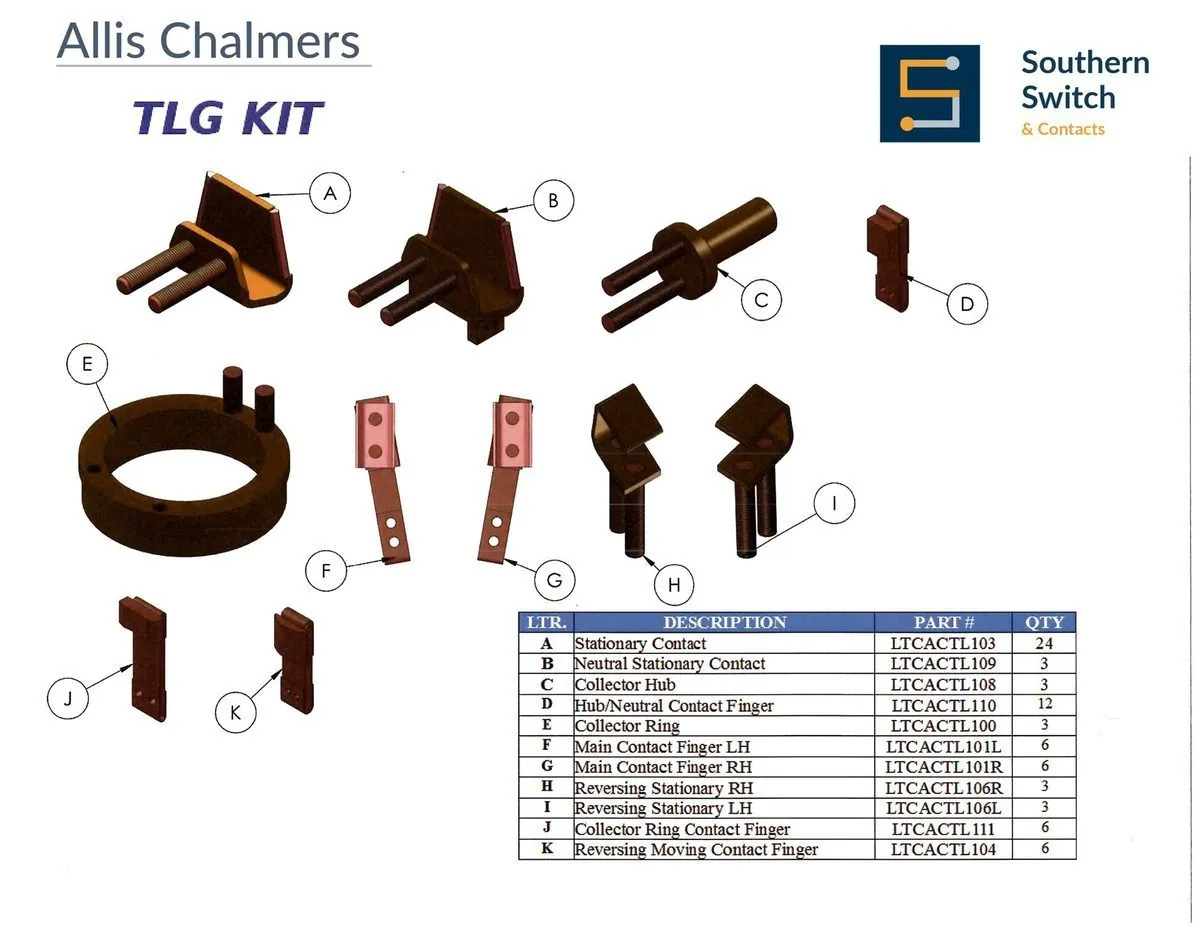
Why transformers need tap changers
A transformer is built around a fixed turns ratio. In a textbook that ratio is enough: primary voltage in, secondary voltage out. In a real substation, primary voltage moves around all day as load shifts across the grid, and the secondary side has to stay inside a ±5% band for the equipment downstream.
Tap changers solve this by adding or subtracting turns from one of the windings. The transformer stays online while the tap moves. A standard LTC has 33 tap positions, sixteen raise, sixteen lower, and neutral, giving ±10% regulation in steps of 0.625%, enough resolution for an automatic voltage regulator to hold the secondary terminal voltage steady.
LTCs vs DETCs
Not every tap changer can switch under load. A de-energized tap changer (DETC) requires the transformer to be taken offline for any tap movement. DETCs are used for seasonal trim, not for regulation.
A load tap changer breaks and re-makes current on every operation. A busy transmission transformer can run an LTC through 10,000+ tap changes a year. That kind of duty needs arcing contacts, transition resistors or reactors, and a diverter mechanism that throws the load from one tap to the next in roughly 40 to 60 ms.
Everything that wears out in an LTC traces back to that interrupting duty.
The two mechanical families
Two designs dominate North American substations.
Resistance-type LTCs(sometimes called diverter-switch LTCs) use a high-speed diverter switch with arcing contacts and transition resistors. The resistors limit circulating current during the tap-to-tap transition. The Reinhausen MR diverter-switch designs and other European units work this way; the GE LR/LRT and McGraw-Edison 550 series are reactance-type designs (see the reactance-type section below). Wear pattern: localized arc pitting on the arcing-contact face, with the main contacts seeing relatively gentle duty.
Reactance-type LTCs(preventive-autotransformer LTCs) use a preventive autotransformer that bridges two adjacent taps for the duration of the transition. Westinghouse URT, UTT, and UVT-2000, Allis-Chalmers TLG and TLH-21, and Federal-Pacific TC-525 and TC-546 are all reactance designs. Wear pattern: arc erosion at the arcing contacts on every operation, plus gradual wear across the main contact faces.
The wear difference matters because it changes the maintenance interval. Reactance-type changers are inspected on an operation-count or time basis set by the manufacturer, often on the order of tens of thousands of operations or a fixed number of years, whichever comes first. High-speed resistance-type changers carry the arcing on a diverter switch built for a large number of operations between overhauls, but the diverter contacts and transition resistors still require periodic service. The governing figure is always the manufacturer's published interval for the specific model, not a generic number.
How LTCs actually fail
Arc erosion comes first. Every tap change vaporizes a few microns of contact material. After enough operations the face goes from polished to cratered, resistance climbs, the contact runs hot, and the heat speeds up everything else.
Mechanical wear is next. Spring-loaded fingers lose tension over thousands of cycles. Pivot bushings develop slop. The clean contact alignment the LTC had at installation drifts off center, and the contact face you can still see is no longer the part actually carrying current.
Oil contamination is the third leg. Carbon from arcing accumulates in the LTC compartment. Dielectric strength drops. Coking on the contacts creates hot spots. Eventually something flashes over.
Signs your LTC is overdue
Rising DGA in the LTC compartment, especially acetylene, ethylene, and hydrogen. Trigger thresholds vary by design, but a step change between annual samples is a louder signal than the absolute reading.
Tap-position counter age. If the manufacturer says inspect at 50,000 operations and your counter shows 80,000, you are working with no margin.
Operator complaints. Sticky response, unusual sounds during a tap change, tap-counter-versus-controller mismatches. Any of these justifies an off-cycle pull.
Repair, refurbish, or replace
Most LTC failures get refurbished, not replaced. A typical refurbishment is: pull the LTC head, swap out the moving and stationary contacts (or re-face them when the wear is light), put in new arcing contacts, inspect the diverter switch components, filter or change the oil, and bench-test the unit before it goes back into the transformer.
The problem is that OEM parts for many vintage LTCs have not been available from the original manufacturer for decades. The Allis-Chalmers TLG. The GE LR65. The Westinghouse URT high-amp. Nobody has stocked those at the factory in a long time.
That is the gap that reverse-engineered replacement parts fill. Same dimensions as the OEM drawing, same contact alloy. The LTC goes back to factory interrupting performance and the transformer stays in service for another 20 to 30 years. SSC machines and refurbishes load tap changer contacts to OEM dimensions, or takes on the full LTC rebuild in the shop.
Send us a model number, a scope, or a photo and we’ll respond within one business day with availability, pricing, and lead time.
Common questions
What is a load tap changer?
An LTC adjusts a transformer's turns ratio under load to hold output voltage steady as primary voltage moves through the day. Unlike a de-energized tap changer (DETC), which requires the transformer offline to move a tap, an LTC regulates continuously while the transformer stays in service.
How do load tap changers fail?
Arc erosion comes first. Every tap change vaporizes a few microns of contact material; after enough operations the contact face goes from polished to cratered, resistance climbs, the contact runs hot, and the heat accelerates further wear.
What are the signs an LTC is overdue for maintenance?
Rising DGA in the LTC compartment, especially acetylene, ethylene, and hydrogen. Trigger thresholds vary by design, but a step change between annual samples is a louder signal than the absolute reading.
Can an LTC be refurbished instead of replaced?
Yes. Most LTC failures get refurbished, not replaced. A typical refurbishment pulls the LTC head, swaps or re-faces the moving and stationary contacts, installs new arcing contacts, and inspects the diverter.