What Is a GOAB Switch?
GOAB stands for gang-operated air break, also written group-operated air break: a three-phase disconnect switch whose blades open and close together from one drive shaft. Depending on the utility, the same equipment may be called a gang operated switch, a high-voltage disconnect switch, a line-break switch, or simply an HV switch. The terminology varies by region; the equipment does not. They do the visible isolation work at substation entrances, transformer tie points, and bus-section breaks. They are simple, reliable, and usually the last thing anyone thinks about until one will not open.
What does GOAB stand for?
GOAB stands for Gang Operated Air Break, also written group operated air break. A GOAB switch is a three-phase disconnect switch whose blades open and close together from one ground-level operator, creating a visible air gap that isolates substation equipment for safe crew work.
Where you find them
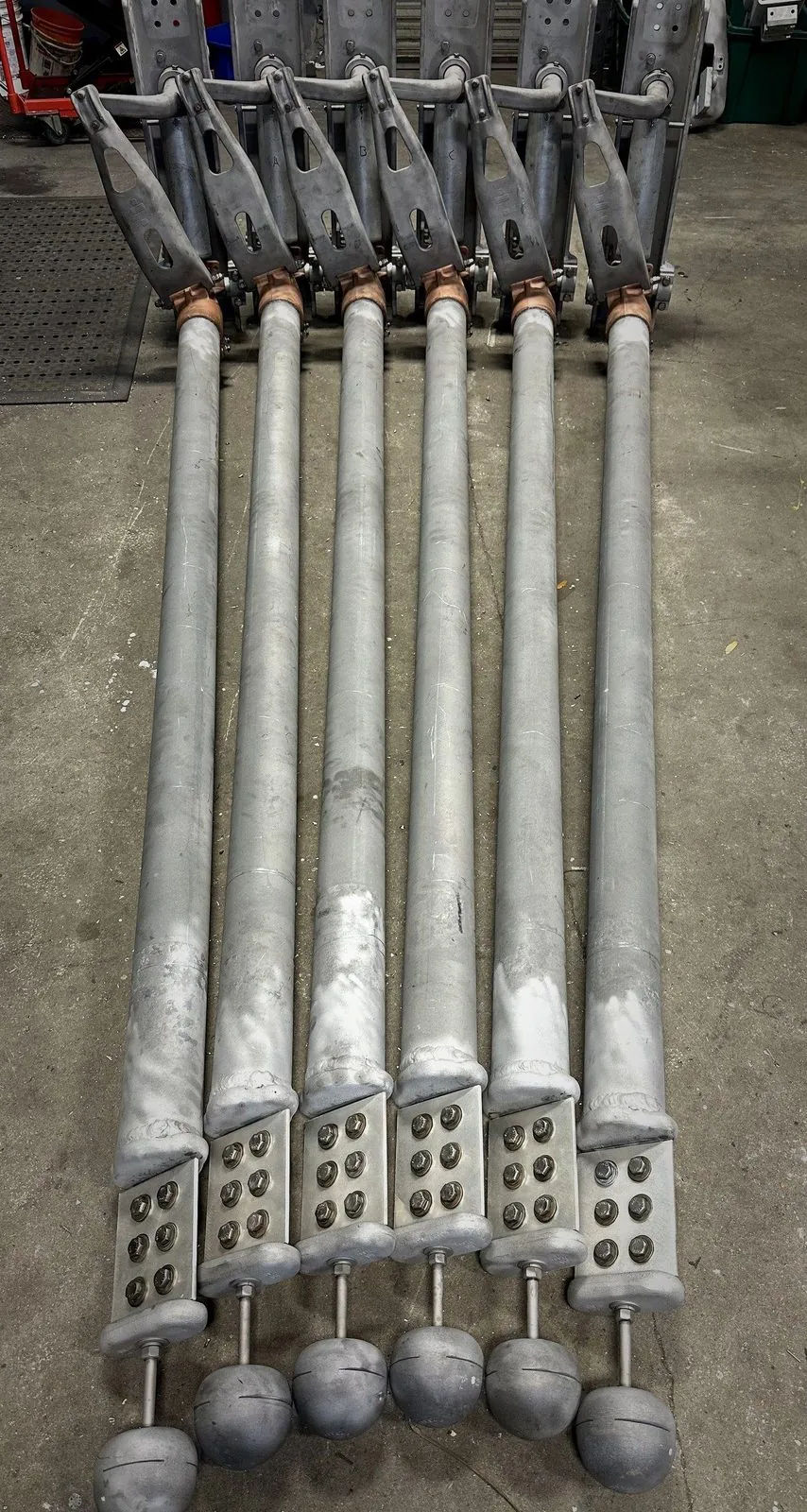
Walk into any utility substation and the most visible piece of equipment is usually a row of GOAB switches mounted high on the steel structure. Three phases, opening and closing in unison from a single mechanical operator at ground level connected through a vertical drive shaft and linkage.
Their job is isolation, not interruption. A GOAB opens after the load has been removed by an upstream breaker. The visible open gap, the air break itself, is the clearance that lets crews work safely on the de-energized side.
Three places they live: at the substation entrance ahead of the main bus, between transformer banks and the secondary bus, and at tie points between sub-buses. Same switch, three jobs.
Configurations and voltage classes
GOAB disconnect switches come in a few blade arrangements: vertical break, where the blade swings up out of a lower jaw, side break, and double side break. Utilities spec them by system voltage, most often 15 kV, 25 kV, 34.5 kV, and 38 kV classes, with higher BIL on the taller structures. A vertical GOAB switch at 15 kV on a distribution substation and a 38 kV side-break unit at a transmission tie do the same job, isolation with a visible air gap, in different envelopes.
The manufacturers you will see
Southern States dominates distribution and sub-transmission voltages in North America. The EV1, EV2, and EV3 series cover 15 kV through 230 kV. The EV2 in particular is the most installed GOAB across the southeastern United States.
Cleaveland/Price shows up at higher voltages and in vertical-break designs at transmission substations.
USCO makes many distribution-class GOABs.
Pascor and a handful of smaller manufacturers serve specific utility specifications and retrofits.
Most of these switches have been in service for 40 to 60 years. Either the original manufacturer no longer supports the design, or they were acquired and the product line was discontinued. Reverse-engineered replacement parts are the realistic path to keeping them running.
How they work
A standard three-phase GOAB has three identical blade-and-jaw assemblies on a horizontal frame. The blades pivot through bearing housings at each phase. A vertical drive shaft connects the assembly to a manual handle (or motorized operator) at ground level. Turning the handle drives a horizontal shaft across all three phases, opening or closing the blades together.
The current path runs from the line terminal, through the jaw contact, along the blade, through the pivot contact at the hub, to the load terminal. Every contact in that chain is a potential resistance and a potential heat source. The contact surfaces are silver-plated copper for low resistance and arc resistance.
Air-break clearances scale with voltage. A 15 kV GOAB has about 12 inches of clearance when open. A 138 kV GOAB has about 60 inches.
Why GOABs fail
Bearings seize first. The pivot bearings live outdoors for decades, accumulating moisture, dust, and salt-spray. Once they stiffen, the operator has to push harder to open the switch. That bends linkages and accelerates wear on everything else. Southern States EV2 bearings are the most common failure we see in southeastern utilities, and salt-laden coastal humidity makes it worse.
Contacts wear and develop hot spots. Open-and-close cycles under no-load are gentle, but silver plating still wears off over decades. Once the underlying copper is exposed it oxidizes, contact resistance climbs, and a thermal-imaging survey will pick up the hot spot before the switch fails.
Linkage gets sloppy. Connecting rods, universal joints, and operator gearing all accumulate slop. A GOAB that needs four or five handle revolutions to open instead of two is telling you the linkage has stretched. Worn linkage, degraded contacts, and seized bearings are what field or shop GOAB switch repair puts right.
Insulators deteriorate. Porcelain post insulators chip, crack, or accumulate contamination tracks. A flashover during operation can take a substation offline and badly damage the switch frame.
The Southern States EV2 in particular
The EV2 is so widely installed that its failure pattern deserves its own paragraph. The original design runs a mild steel shaft against an aluminum lock nut, no barrier between the dissimilar metals. That works fine for most environments. In coastal Florida, salt-laden humidity drives accelerated galvanic corrosion between the dissimilar metals, and we see the bearing seize on a 10 to 15 year cycle.
Southern Switch & Contacts builds a stainless-shaft upgrade for the EV2 bearing. The kit replaces the mild steel shaft with a 316 stainless shaft running in stainless bearings, adds new brass lock nuts, and seals the assembly with Viton O-rings. It installs with no structural modification to the switch frame. The upgraded bearing comes back to like-new condition and outlasts the original.
For utilities running EV2 switches in coastal or industrial environments, the stainless upgrade during routine maintenance is a one-time fix that ends the recurring bearing-replacement work.
Running a GOAB maintenance program
Annual substation inspections (semi-annual for transmission) should always include the GOABs. The checklist is short: operator effort during a test cycle, blade alignment when fully closed, contact-finger spring tension, IR scan during the load survey, insulator visual, and linkage hardware torque.
Catching a stiff bearing or a hot contact during an inspection is a planned maintenance event. Finding it when the switch will not open during a crew callout is an outage.
When an inspection turns up mechanical wear, degraded contacts, seized bearings, or a switch that no longer operates cleanly, Southern Switch refurbishes GOAB switches across all voltage classes. When the specific problem is a worn or seized gear operator, the UGOR replaces the operator without rebuilding the mounting structure. Those are two different paths: refurbishment restores the switch itself, the UGOR replaces the operator that drives it.
GOAB switch FAQ
What does GOAB stand for?
GOAB stands for gang-operated air break, also written group-operated air break. All three phase blades are ganged to one operating mechanism, so a single ground-level handle or motor operator opens and closes the whole three-phase switch at once.
What is a GOAB switch and what does it do?
A gang-operated air-break (GOAB) switch is a three-phase disconnect that opens all three phases simultaneously from a single ground-level operator, creating a visible air gap that isolates a section of bus or equipment for safe crew access. Its job is isolation, not interruption. It is opened after an upstream breaker has already removed the load, not under fault or load current.
Why do GOAB switches fail?
Bearing seizure is the most common failure. The pivot bearings operate outdoors for decades accumulating moisture, dust, and corrosion, eventually stiffening the mechanism, which forces harder operation, bends linkages, and accelerates wear throughout. Contact oxidation is the next cause: silver plating wears off over time, the underlying copper oxidizes, contact resistance climbs, and the hot jaw will appear on a thermal scan before the switch fails outright.
What is a Southern States EV2 and why is bearing failure so common on them in Florida?
The Southern States EV2 is the most widely installed GOAB switch across the southeastern United States, covering 15 kV through 230 kV substations. Its original design runs a mild steel shaft against an aluminum lock nut, adequate in most climates but vulnerable to Florida's coastal salt humidity, where the dissimilar metals corrode and cause bearing seizure on a roughly 10 to 15 year cycle. A stainless-shaft upgrade using a 316 stainless shaft and stainless bearings, with Viton O-rings and brass lock nuts, eliminates the corrosion failure mode without modifying the switch frame.
Send us a model number, a scope, or a photo and we’ll respond within one business day with availability, pricing, and lead time.