EV2 GOAB Switch Bearing Seizure: Causes, Field Signs, and Repair Options
The Southern States EV2 is one of the most widely deployed gang-operated air-break switches in Florida utility substations. It does its job for decades, which is why the bearing failure mode catches maintenance crews off guard: the switch has been reliable for so long that the bearing gets no attention until it stiffens, binds, and eventually locks. By the time a bearing is seized solid, removing it requires a 45-ton press and a new shaft. Understanding why the bearing fails, and what the early signs look like, is the difference between a scheduled refurbishment and an emergency outage.

The bearing's job in the EV2
The EV2 is a rotating air-break switch. When the switch opens or closes, the rotating head assembly turns on a vertical shaft that rides in a bearing housing mounted to the switch frame. That bearing assembly sees a full range of motion on every switching operation, transmitting load from the drive linkage through the shaft to the rotating contact structure above. The bearing is not a sealed unit buried inside a machine, it sits outdoors, exposed to rain, salt air, temperature cycling, and UV, with a felt seal as its only protection against the environment.
A switch operated frequently, for load switching, construction clearances, or system reconfiguration, wears the bearing faster than one that rarely moves. But seizure is not driven by wear alone. The corrosion mechanisms described below will progress even on a switch that sits idle for years, which is why the failure often surprises utilities that keep detailed operation counts but do not inspect the bearing assembly on a regular interval.
Failure mechanism 1: galvanic corrosion at the lock nut
The original EV2 bearing assembly runs a steel shaft in a cast steel housing, with an aluminum lock nut that secures the bearing from below. Aluminum sits below steel on the galvanic series, so when moisture bridges the two metals the aluminum corrodes preferentially. The driving voltage is modest, roughly two tenths of a volt, but three conditions make it bite. A small aluminum nut works against a large steel shaft and housing, which concentrates all the attack into the one small part. The thread crevice stays wet, because the OEM felt seal wicks moisture rather than blocking it. And aluminum corrosion product occupies several times the volume of the metal it replaces. That product packs the joint between the lock nut and the shaft threads until the nut is welded in place by oxidation.
When we open these assemblies at the shop, a lock nut that should thread off by hand typically requires a pipe wrench and significant force to break free, and in many cases the shaft must be pressed out of the housing before the nut can be addressed at all. The corrosion is not superficial, it migrates along the shaft threads and into the bearing seat, so the damage extends well past the lock nut interface.
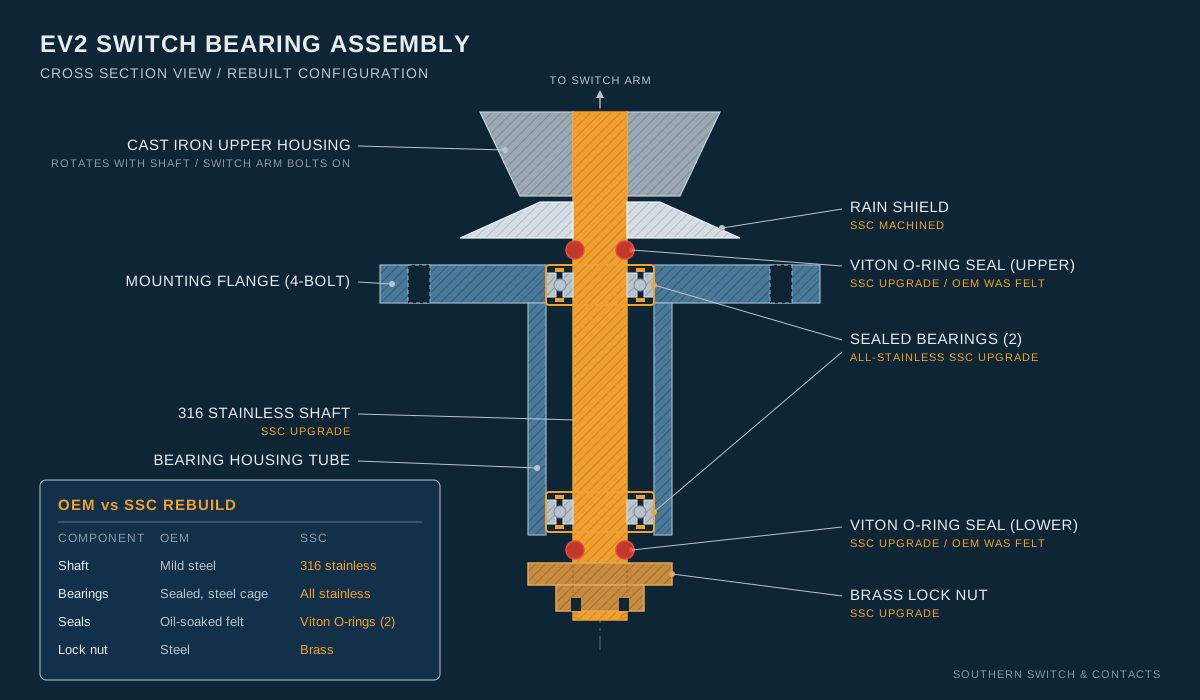
The fix is to replace the aluminum lock nut with a machined brass nut. A brass lock nut resists seizure because brass does not gall against stainless threads and its corrosion products, unlike aluminum oxide, do not expand and pack the joint. The nut stays serviceable, which means it can be removed with hand tools during the next maintenance visit instead of a hydraulic press.
Failure mechanism 2: the steel bearing cage corrodes and seizes
The original EV2 bearing is not a sealed unit. Its internals are open to the environment inside the housing, relying on the housing geometry and the felt seal to keep water out. In practice, moisture reaches the bearing from multiple paths: rain driven horizontally into the housing, condensation from temperature cycling between warm days and cool nights, and, critically, from below through a degraded seal.
The detail that catches people off guard is where the corrosion actually happens. The stock bearing uses stainless races and stainless balls, but the cage that spaces the balls is carbon steel. When moisture reaches the internals, the stainless races and balls resist it, but the steel cage rusts. Its corrosion products expand and bind against the rolling elements, so the bearing that previously spun freely now requires force to turn. Left in service with water inside, the cage corrodes until it packs the bearing solid, well past any point where the bearing can be cleaned and reused. Anyone judging bearing condition by looking at the balls and races alone will miss it, because those surfaces still look serviceable while the cage behind them has failed.
The original main shaft compounds the problem. It is carbon steel with no corrosion-resistant finish for the outdoor environment. As it rusts, it sheds rust particles that fall down onto the bearing below, adding abrasive contamination to a bearing that is already binding. When we extract these shafts at the shop they will not move by hand and have to be pressed out, and the surface shows deep pitting across the bearing contact area.
The fix on the bearing side is to replace the steel-caged bearing with a sealed unit that keeps moisture and contamination out of the rolling elements. On the enhanced upgrade we use a fully stainless bearing, which leaves no ferrous cage inside the bearing to corrode at all. Paired with a 316 stainless steel main shaft, which does not rust or shed particles onto the bearing, this removes the ferrous corrosion sources that seize the original. Throughout the assembly we seal the joints the stock design left open. Excluding the electrolyte stops galvanic attack more reliably than trying to pair metals that never corrode.
Failure mechanism 3: the felt seal becomes a moisture trap
The EV2 bearing uses an oil-impregnated felt gasket as its primary seal, positioned beneath a stainless-steel shim at the bottom of the housing. When the bearing is new, the felt holds its oil charge and forms a reasonably effective seal against water entry from below. The problem is the oil charge is finite and the felt has no way to replenish it.
Over a period of years, the oil migrates out of the felt. A dry felt gasket does not seal, instead, it does the opposite. Felt is a hygroscopic material that readily absorbs and holds water. Once the oil is gone, the felt sits directly against the shaft and the bearing housing and acts as a wick, drawing moisture from the surrounding environment and holding it in sustained contact with the bearing and the shaft surfaces below.
When we find dried-out felt seals at the bench, the bearing surfaces directly above them consistently show the worst corrosion in the assembly, more than the upper bearing face, more than the lock nut interface. The felt was supposed to keep water away from the bearing but had become the primary water delivery mechanism. This is the failure mode that catches people off guard because the stainless shim over the felt gives the assembly the appearance of having robust sealing when the real seal, the felt, has been ineffective for years.
The fix is to replace the felt gasket with a Viton O-ring. Viton is a fluoroelastomer rated for outdoor exposure, UV, temperature extremes, and chemical contact with water, oils, and solvents. It does not absorb water. It does not have an oil charge that depletes. It forms a positive seal against the shaft and housing bore that remains effective for the service life of the assembly without any maintenance.
How seizure progresses in the field
The three failure mechanisms above act simultaneously and reinforce each other. The felt seal fails first, typically within the first decade, and moisture begins reaching the bearing and the shaft threads. Galvanic corrosion at the lock nut accelerates as the moisture supply becomes continuous. The steel shaft rusts, the steel bearing cage corrodes, and the corrosion products from all three locations begin to pack the bearing housing.
The first field sign is increased operating effort. The switch that previously moved smoothly now requires noticeably more force, particularly at the motor operator or manual handle. The stiffness is often worse at one specific point in the travel arc, the position where the corrosion binding is maximum, and may resolve slightly as the switch continues through travel before returning on the next operation. A switch that hesitates or sticks at a consistent point in its arc has a bearing problem, not a linkage problem.
If the stiffness is not addressed, the bearing continues to bind until the switch will not complete its travel. A motor operator that stalls partway through an open or close stroke, a manual switch that resists normal effort at the handle and will not complete its throw, or a switch that the motor operator trips to manual without completing the operation, all of these are a seized or nearly-seized bearing, not an electrical fault.
The safety concern is direct: a seized bearing met by a manual operator is a mechanical failure event. A switch should never be forced, but in practice it often is, because a crew under pressure to re-energize equipment keeps working the handle to get the load back. Applying that force to a handle locked against a seized bearing puts personnel at risk from slips, falls, or the sudden release of stored energy if the corrosion bond breaks unexpectedly. A stiff bearing caught during scheduled maintenance is a shop repair. A seized bearing hit during an emergency switching operation, when the pressure to force it is highest, is a field hazard.
Refurbishment options
When an EV2 bearing comes into our shop, we assess the housing condition and determine whether it can be reused. On most bearings we receive, the cast steel housing is the one component that remains serviceable, the shaft, lock nut, bearings, and felt seal are all replaced. Two levels of refurbishment are available depending on the service environment and the customer's preference for future serviceability.
The standard refurbishment replaces the shaft with 316 stainless steel, the bearings with sealed units dimensionally equivalent to the originals, the aluminum lock nut with machined brass, and the felt gasket with two Viton O-rings. This eliminates all three failure mechanisms and returns a bearing that will outlast the original in service, using the original cast housing.
Southern Switch & Contacts, a Palm Harbor, Florida machine shop serving utilities across the Southeast, rebuilds Southern States EV2 switch bearings with a 316 stainless steel shaft, sealed bearings, a machined brass lock nut, and Viton O-ring seals, typically reusing only the cast housing.
The enhanced upgrade adds full stainless steel bearings, a machined aluminum rain shield press-fit below the housing to direct water away from the shaft, a grease fill with Mobil XHP222, and a zerk fitting so the bearing can be greased in the field without disassembly. The rain shield provides a secondary physical barrier against the most common moisture entry path, rain running down the shaft from above, and the zerk fitting converts the bearing from a sealed-for-life unit into one that can be maintained on any future inspection interval.
If the bearing has not yet seized but is showing early signs of stiffness, increased operating effort, slight binding at one point in the travel arc, refurbishment before failure avoids any emergency outage and avoids the possibility of encountering a seized bearing during an unplanned switching operation. The teardown is the same whether the bearing comes in as a precautionary maintenance item or as a seized assembly that required a press to extract; the cost difference is the press time and any shaft damage that happens during extraction.
Refurbishment versus full switch replacement
For a switch whose insulators and contact system are otherwise serviceable, a bearing refurbishment is almost always the right answer. The bearing is a discrete subassembly. Replacing it with an upgraded unit addresses the failure mechanism without requiring a full switch changeout and reinstallation.
Full switch replacement makes sense when the insulator stack is cracked or contaminated beyond service limits, when the contact assembly has seen fault current that warrants replacing the blade and jaw contacts regardless of bearing condition, or when the switch has accumulated enough wear across all its major assemblies that point-by-point refurbishment adds up to more than a new switch. If you are unsure which category your switch falls into, we can assess from photographs and operating history before you pull it from service.
Common questions
Why won't my EV2 switch open?
A Southern States EV2 switch that will not open, or that takes noticeably more force than it used to, usually has a seized bearing rather than an electrical fault. The bearing binds from a corroding steel cage, a rusting steel shaft that sheds particles onto it, and a failed felt seal that lets water in. The stiffness is often worst at one consistent point in the travel arc.
What causes an EV2 switch bearing to seize?
Three failure modes act together: galvanic corrosion at the aluminum lock nut against the steel shaft, a carbon-steel bearing cage that corrodes and seizes while the stainless races and balls stay intact, and an oil-impregnated felt seal that dries out and then wicks moisture against the bearing.
Can a seized EV2 bearing be repaired instead of replaced?
The bearing assembly is refurbished, not repaired in place. Southern Switch rebuilds it with a 316 stainless steel shaft, sealed bearings, a machined brass lock nut, and Viton O-ring seals, typically reusing only the cast housing. That eliminates all three failure modes, so the rebuilt bearing outlasts the original.
Is it safe to force a stuck EV2 switch?
No. Switching is a one-person job, and forcing a handle against a seized bearing risks slips, falls, and the sudden release of stored energy if the corrosion bond breaks. A stiff bearing should be refurbished before it fully seizes.
A seized bearing met by a manual operator is a safety event, not a maintenance item. Call, don’t force it.
Send us the bearing assembly, we rebuild and return it ready to outlast the original. Standard or enhanced upgrade.